How to choose
Choosing a desk and chair for a room that is not an office
Most Australian home desks go into a bedroom or lounge. The four measurements, the chair adjustment range and the warranty terms that decide the purchase.
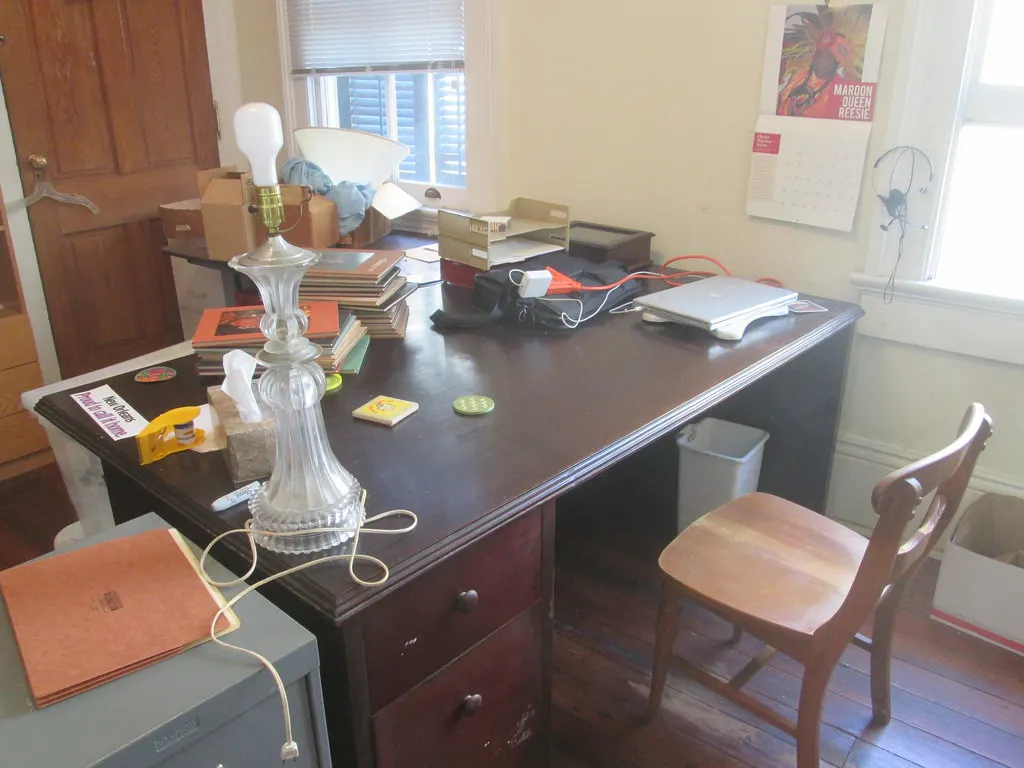
A desk is the only piece of furniture people buy by its top size and then install by its floor size. The two are different, and the gap between them is why so many home desks end up pushed against a wall at an angle, with the chair blocking a doorway.
This guide works through the decision in the order the room forces: floor space first, then depth, then the chair, then what the warranty and the Australian Consumer Law give you if something fails. Every price below is an example used to show the arithmetic, not a price we are quoting; no live price feed is connected to this site.
Start with the room, not the desk
In August 2025 the Australian Bureau of Statistics found that 36% of employed people usually worked from home, and that the figure splits sharply by occupation: 59% of managers and professionals against 21% of everyone else. The practical consequence is that most home desks in Australia are going into rooms that already have another job — a bedroom, a lounge end, a hallway nook — rather than into a dedicated study.
A desk has three footprints, not one. There is the top itself, there is where the chair sits when it is rolled back far enough for a person to stand up, and there is the path somebody walks to get out of the room. A 1,400 mm by 700 mm top sounds modest until you add the 900 mm the chair needs behind it.
Put masking tape on the floor for all three before you shortlist anything. Ten minutes of tape saves a return, and returns on flat-pack furniture are the one part of this purchase where the freight usually costs more than the discount you chased.
| Desk top | Top footprint | Chair rolled back | Total depth to allow |
|---|---|---|---|
| 1,200 x 600 mm | 0.72 m2 | 900 mm | 1,500 mm |
| 1,400 x 700 mm | 0.98 m2 | 900 mm | 1,600 mm |
| 1,600 x 800 mm | 1.28 m2 | 900 mm | 1,700 mm |
Total depth is desk depth plus 900 mm. The 900 mm is the distance a typical task chair travels backwards before a seated person can stand clear of the desk edge; measure your own chair on the floor it will live on, because a rug adds resistance and changes the number.
Depth decides what fits on the desk; width only decides how much
Width is forgiving. If a 1,600 mm top will not fit, a 1,200 mm top holds the same screen and keyboard with less room for paper. Depth is not forgiving, because depth is consumed by things that have fixed sizes: the monitor stand or arm, the clear run in front of the keyboard, and the rear clearance a clamp needs.
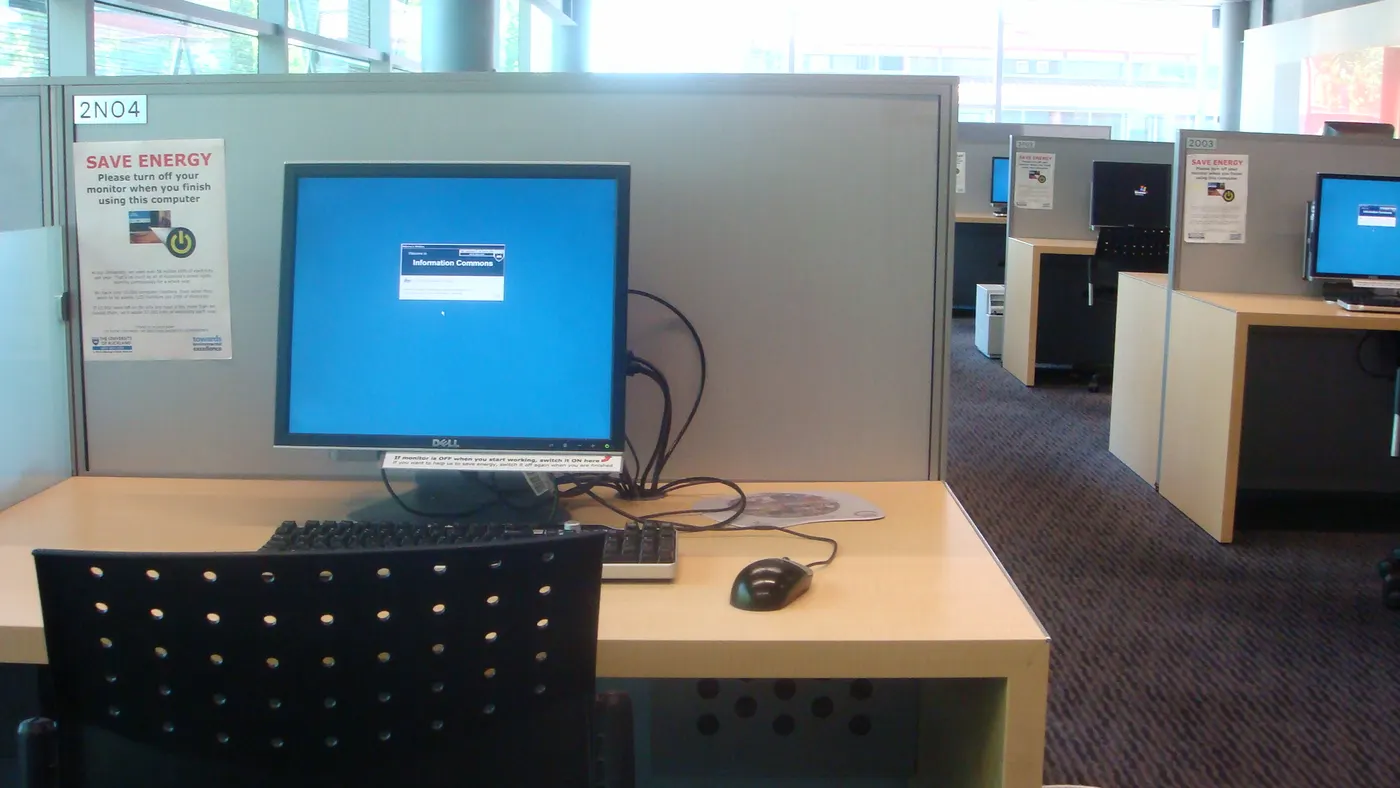
A 27-inch monitor on its own factory stand typically occupies 200 to 250 mm of depth at the base. A clamp-on arm removes that but needs 40 to 60 mm of free desk edge behind the top to tighten onto, and it needs the desk to have a flat rear lip rather than a rolled or recessed one. On a 600 mm deep top, a stand-mounted screen leaves roughly 350 mm in front of it, which is a keyboard and almost nothing else.
This is why a 700 mm deep desk and a $120 monitor arm often beat an 800 mm deep desk at the same total outlay. The arm buys back about 200 mm of usable depth for a fixed cost, and it keeps working when you replace the screen.
- Monitor on its factory stand: 200 to 250 mm of depth, and the screen cannot move back further
- Clamp-on arm: needs 40 to 60 mm of clear, flat desk edge at the rear and a top at least 18 mm thick
- Keyboard and forearms: allow 250 mm from the front edge before anything else goes down
- Laptop used alongside a monitor: another 250 mm of depth unless it goes on a vertical stand
- Power board and cable slack: 50 to 80 mm behind the desk, or the desk never sits flush against the wall
Warranty years, and what the law adds on top of them
A manufacturer's warranty is a promise with a number of years on it, and those numbers differ widely between the frame, the gas lift, the castors and the upholstery. A chair advertised with a 10 years warranty frequently means 10 years on the frame and 2 years on the mechanism, which is the part that actually fails. Read the warranty table rather than the headline figure.
Separately from any warranty, the Australian Consumer Law gives consumer guarantees that a seller cannot remove. The Australian Consumer Law site states that the rules protect buyers anywhere in Australia and apply uniformly across every state and territory; it is a navigation hub rather than a schedule of thresholds, so the detail sits with the state and territory regulators it links to. The useful point for furniture is that a guarantee runs for as long as a reasonable person would expect the goods to last, which for a desk is measured in years, not in the length of the warranty card.
Standards Australia publishes the Australian Standards that office furniture is built and tested to, and sells them through its Standards Store under 3, 6 or 12 month licences rather than publishing the text free. That means a retailer's claim to meet a standard can be checked by number even when the text is paywalled, and a product that names no standard at all has told you something too.
Spend it in this order
On an example total of $1,520 for a desk, chair, monitor and arm, the allocation that survives longest in a shared room is roughly $600 to the chair, $450 to the desk, $350 to the monitor and $120 to the arm. The chair takes the largest share because it is the only item of the four that is in contact with you for 8 hours a day.
The order below is a buying order, not a ranking of quality. If the budget only stretches to two of the four this year, the chair and the arm are the two that make an existing desk workable; the reverse is not true.
- Tape out total depth on the floor: desk depth plus 900 mm, and check a person can still walk past
- Buy the chair first, with the castors matched to the floor already in the room
- Buy the desk to the depth the room allows, taking width as the thing that gives
- Add a monitor arm before a bigger desk; it buys back about 200 mm of depth for about $120
- Keep the warranty document and the model number together, because a consumer guarantee claim needs both
Before you buy
- Tape the total depth on the floor: desk depth plus 900 mm for the chair to roll back
- Measure the height from the floor to the underside of the desk, and the chair's lowest armrest position
- Confirm the castors supplied are rated for the floor already in the room, and price a replacement set
- Check the desk has a flat rear lip at least 18 mm thick if you intend to clamp a monitor arm
- Open the warranty table and note the separate terms for frame, mechanism, castors and upholstery
- Record the model number and keep it with the receipt, because a consumer guarantee claim needs both
Questions readers ask
- Is a sit-stand desk worth the extra outlay in a small room?
- It changes the depth question, not the footprint. A sit-stand frame occupies the same floor area as a fixed desk and adds 20 to 35 kg of frame weight, so the room cost is identical. What it adds is a reason to clear the desk top, because anything unsecured moves every time the desk does. On an example $1,520 total it roughly doubles the desk line, which comes out of the chair.
- Does a corner desk fit more into a small room?
- It fits more desk top into the same wall length, and less usable floor into the room. The chair still needs 900 mm behind it, but on a corner unit that 900 mm swings through the diagonal rather than straight back, so the clear area needed is larger, not smaller. Corner desks earn their space when two screens are permanent and the room has a genuinely unusable corner.
- How long should a desk and chair last before replacement is reasonable?
- A steel-framed desk with a laminate top and a task chair with a replaceable gas lift are both in the 10 years range if the parts are available. The gas lift is the usual first failure and is a $40 to $70 part on most chairs. That replaceability, rather than the warranty length, is the thing worth confirming on the specification sheet before you buy.
- Should the monitor go on the long wall or facing the window?
- Neither, if you can avoid it. A screen facing a window puts the bright surface behind the dark screen and forces constant pupil adjustment; a screen backing onto a window puts daylight reflections on the panel. Daylight arriving from one side, along the desk rather than through it, is the arrangement that needs the fewest blinds and the fewest lamps.
Sources
- Australian Bureau of Statistics — Working arrangements, August 2025 (36% of employed people usually worked from home; 59% of managers and professionals against 21% of other occupations) — checked 2026-11-03
- Australian Consumer Law — consumer rights and protections overview (rules apply uniformly across every state and territory) — checked 2026-11-03
- Standards Australia — how Australian Standards are developed and purchased (Standards Store, 3, 6 and 12 month licences) — checked 2026-11-03
Some links on this site can earn us a commission. That does not change which product a guide recommends, and it adds nothing to your price. Advertising is not enabled on this site yet. When it is, ads will be labelled and kept visually separate from the guides.